Showing posts with label delegation. Show all posts

Wednesday, July 29, 2015

Leadership: Delegate Or Die - Douglas E. Castle

Share this ARTICLE with your colleagues on LinkedIn .


Leadership: Delegate Or Die
One Of the Most Important Responsibilities Of A Leader Is To Delegate Responsibility
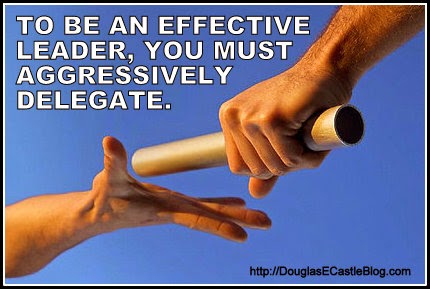


To be a leader and to maintain a position of leadership, you must be a competent and efficient delegator. By the act of delegating, you are not relinquishing control – you are actually expanding the realm and scope of your control. The larger the responsibilities and the larger the organization, the more proficient you must be at delegation.

In the military, “delegation” is defined as the action by which a commander assigns part of his or her authority commensurate with the assigned task to a subordinate commander. While ultimate responsibility cannot be relinquished, delegation of authority carries with it the imposition of a measure of responsibility. The extent of the authority delegated must be clearly stated.

Your success at delegation will determine the strength and length of your reign as a leader and commander. The most significant insights and skills which are required in successful delegation are listed below. They are worth studying:

==+ If you are obsessive-compulsive by your nature, do all that you can to rationally counterbalance this dangerous impediment to effective delegation. You cannot micromanage and be a leader. You cannot be the servant of your subordinates because you are insistent about things being done exactly as you would have them done;

==+ You must constantly keep the big picture and the broader focus in mind. If you are a perfectionist and overly detail-oriented, you will never be able to attain your organizational objectives while mired in minutiae;

==+ Understand all of your responsibilities, and itemize or componentize each of them. You'll find that each individual component can be delegated (as it must) to someone in your organization whom you can select. If the right individual is not among your inventory of Human Assets, then you must either replace some of your people, or your must acquire some new members with the requisite skill sets. The objective is to export as many of your responsibilities as possible, while retain the central responsibility of organizational stewardship, oversight and goal attainment;

==+ When you delegate responsibility for the accomplishment of a task or function, also remember to grant the requisite authority and to impose the necessary accountability to the person to whom you've charged with the job. Responsibility without authority is a recipe for managerial impotence and non- performance. Responsibility without accountability is a recipe for waste, abuse and failure;

==+ Since you, as a leader, are ultimately responsible for the successful and efficient attainment of your organization's most important goals, you must constantly monitor the performance of those to whom you've delegated, without being drawn in to correcting their mistakes yourself. Observe, measure, suggest, monitor and determine whether the subject task has been assigned to the right individual; sometimes a change may be warranted.

==+ Where you observe leadership potential in some of those persons to whom you've delegated tasks, you may find it wise to increase their roster or responsibilities, but to also grant them greater authority to sub-delegate to others who are subordinate to them. Remember that the greatest leaders know how to identify and cultivate leadership within their organizations. Be aggressive and bold about identifying and leveraging the leadership talents of other leaders within your organization. Encourage leadership and acceptance of increased responsibility. Reward it and give it appropriate recognition. Empowering other leaders liberates you to be a greater leader yourself.

==+ As you develop leaders and assign them to their respective specialty areas (not unlike fiefdoms within a kingdom), clearly identify where each one's territory begins and ends. Clearly define their responsibilities with minimal overlap. Keep your subordinate leaders separated from each other (unless you are present and orchestrating or conducting a meeting or hearing reports) – fiefdoms should not compete, but neither should their feudal lords unite, lest they undermine the king's leadership. 

In brief, don't permit your subordinates to take you over. Delegate, but do so without ever permitting your absolute command from being undermined. Keep your emerging leaders separated from each other, and even instill a competitive spirit amongst them to 'fight' for your approval.

As always, thank you for reading me. 


Douglas E Castle 

Join me on Linked In
Please Follow GEI Consulting On LinkedIn

Please Like GEI Consulting On Our Facebook Page

Please Follow GEI Consulting On Google Plus  


Labels, Tags, Keywords, Categories And Search Terms For This Article:
Douglas E. Castle, leadership, management, delegation, responsibility, authority, taking command, grooming leaders, accountability, business, career advancement, self-promotion, personal power, organization, GEI Consulting, The Taking Command Blog


---------------


Respond To Douglas E Castle
http://bit.ly/CASTLEDIRECT

TAKING COMMAND - Douglas E. Castle

TAKING COMMAND! ACHIEVING YOUR OBJECTIVES.

http://takingcommand.blogspot.com

The Guide to self-mastery, goal-setting, strategic planning and decision making, leadership, management, contingency planning, leveraging assets, rule and domination, choosing allies, dealing with enemies, assessing risk, time management, negotiation... achieving personal authority, influence, wealth and success through total TRANSFORMATION.

Key Terms: Leadership, management, self-growth, self-mastery, personal power, career advancement, negotiation, winning, wealth, success

Tuesday, July 16, 2013

The Only Leadership Journal! 07.16.2013

Share this ARTICLE with your colleagues on LinkedIn .


LEADERSHIP JOURNAL
A perfect supplement to The Taking Command Blog by Douglas E. Castle.
avatar Published by
BLOG BUILDERS!
13 July 2013
Education Business Technology Society Politics Sports #leadership #management
Today's headline
e-Newsletter July 2013: Is Your Strength Your Blind Spot? - Center for Creative Leadership
Shared by
ccl.org
thumbnail www­.ccl.org - That's the message — and the title of a new book — from Bob Kaplan and Rob Kaiser. In Fear Your Strengths: What You Are Best At Could Be Your Biggest Problem, the longtime leadership consulting duo...

Advertisement

Start taking a college level music theory class today.
This beginner class is now accessible to aspiring musicians of all ages. Learn all of the basic concepts in an easy to follow manner.

132 contributors - featured today:


TAKING COMMAND!

View DOUGLAS E. CASTLE's profile on LinkedIn

Douglas E Castle
All Blogs & RSS Feeds

Share this page
Contact Douglas Castle
Follow Me on Pinterest


CFI, C.F.I., CrowdFunding Incubator,  crowdfunding, crowd funding, incubators, accelerators, finance projects, listing services, start up, small business, SME, funding, capitalization, financing, leverage, company services, management, marketing, fundraising, technology, mentoring, advice, media, branding, memes, business tips tricks tools and resources, entrepreneur, forum, discussion, applications, technologies, risk assessment, business model, strategic planning, organizational development, connections, networking, early-stage, first-round, angel  funding, venture capital, credit lines, assistance, business growth, biz builders, social media power, delegation, automation, monitoring, metrics, brainstorming, meetups, joint ventures, partnerships - http://CFICrowdFundingIncubator.blogspot.com, http://www.CrowdFundingIncubator.com, marketing, messaging, news releases, free, gain market share, increase backlinks, SEO, influence, disruption theory, directory, RSS feeds, Douglas E. Castle, blogroll, blogs, crowdfunding blogs...


***
View DOUGLAS E. CASTLE's profile on LinkedIn

Douglas E. Castle - Blogger Profile
CFI - Notes From The CEO
Instant Musical Counterpoint - Relax!


Scoop.it

Wednesday, December 12, 2012

Leaders And Managers: Different Species

Share this ARTICLE with your colleagues on LinkedIn .


Leaders and managers have many elements in common, but each is its own specialty. Rarely is a great leader a good manager. Rarely is a great manager a good leader.


In industry, a leader is predominantly a charismatic visionary who is able to communicate a vision and get others to follow -- he or she may be the chairman or CEO of a company or organization.


Great managers generally become masterful Chief Operating Officers, who are primarily responsible to see to the attainment of the leader's vision through the use of Human and other assets. A truly effective COO is an expert at the arts of talent scouting, delegating and automating of processes. Project Managers who are unusually good at social interaction (geeks need not apply -- this is a position that involves frequent Human contact with a variety of personality types) generally make the finest Chief Operating Officers.


The most powerful C-Suite pairing is that of a charismatic, no-nonsense CEO with a potent, organized, project-oriented COO.


The starkest part of the difference between leaders and managers is that leaders have a propensity to be egotistical and a bit sociopathic, while managers are, on the whole, less likely to be prima donnas and are reasonably content to let their egos take a back seat while they enjoy the rewards of good recruitment, smart delegation and the creation of the systems which lead to the accomplishment of specified objectives. Leaders are invariably more narcissistic and self-obsessed.


While you may not find this in a great number of MBA textbooks, very few leaders will ever become good managers, while it is more likely that a truly outstanding manager may rise to the position of being a leader.


As always, thank you for reading me and for re-tweeting me.

Douglas E. Castle


TAKING COMMAND!

View DOUGLAS E. CASTLE's profile on LinkedIn

Douglas E Castle
All Blogs & RSS Feeds

Share this page
Contact Douglas Castle
Follow Me on Pinterest


CFI, C.F.I., CrowdFunding Incubator,  crowdfunding, crowd funding, incubators, accelerators, finance projects, listing services, start up, small business, SME, funding, capitalization, financing, leverage, company services, management, marketing, fundraising, technology, mentoring, advice, media, branding, memes, business tips tricks tools and resources, entrepreneur, forum, discussion, applications, technologies, risk assessment, business model, strategic planning, organizational development, connections, networking, early-stage, first-round, angel  funding, venture capital, credit lines, assistance, business growth, biz builders, social media power, delegation, automation, monitoring, metrics, brainstorming, meetups, joint ventures, partnerships - http://CFICrowdFundingIncubator.blogspot.com, http://www.CrowdFundingIncubator.com, marketing, messaging, news releases, free, gain market share, increase backlinks, SEO, influence, disruption theory, directory, RSS feeds, Douglas E. Castle, blogroll, blogs, crowdfunding blogs...

Sunday, May 13, 2012

Effective Leaders: The Required Persona

Share this ARTICLE with your colleagues on LinkedIn .


The Present Moment Is Consumed By The Vastness Of Its Absence - Douglas E. Castle


Effective leadership requires a certain persona, a certain image to subordinates, peers and the public in order that it may command the responsiveness and attention which it deserves. Watch such high-tech leader-team-oriented series as NCIS, The Unit, Criminal Minds, and a host of others [hopefully less graphic and violent], and note that the leader figures tend to exude the following attributes:

1) They appear a bit older than their charges or teammates;

2) They tend to have more scars (visible, physical) than their charges or teammates; they also tend to be:

3) Fearless and brave;

4) Confrontational if provoked;

5) Fast thinkers, but tending to keep their own counsel;

6) Expectant that their orders will be followed unquestioningly;

7) Difficult to impress;

8) Physically intense, and unafraid to invade another person's personal space;

9) Comfortable with every aspect of leadership and command;

10) Direct, effective oral communicators on a person-to-person or a person-to-group level;

11) Low-tech! -- While the exceptions may be the late Steve Jobs, Bill Gates, and U.S. President Barack Obama, for the most part these leaders eschew apps and gadgets and prefer to act on hunches (intuition) and facts gathered by their technological support personnel, i.e., their in-house computer wunderkind-types, nerds, geeks and others suited more to brilliant back office analyses than to fronting the band or seizing the podium and demanding attention.

In persona, a leader is many things, some of which seem conflictory or anomalous. The one that I find most fascinating is that these figures are always intimidating, yet others (followers, employees, charges, recruits, trainees, students, subordinates, audiences...) desperately want their approval and even crave closeness to them.

Douglas E. Castle for The Taking Command Blog

TAKING COMMAND!

View DOUGLAS E. CASTLE's profile on LinkedIn


Douglas E Castle
All Blogs & RSS Feeds

Share this page
Contact Douglas Castle

BLOG ARCHIVE

Bookmark and Share